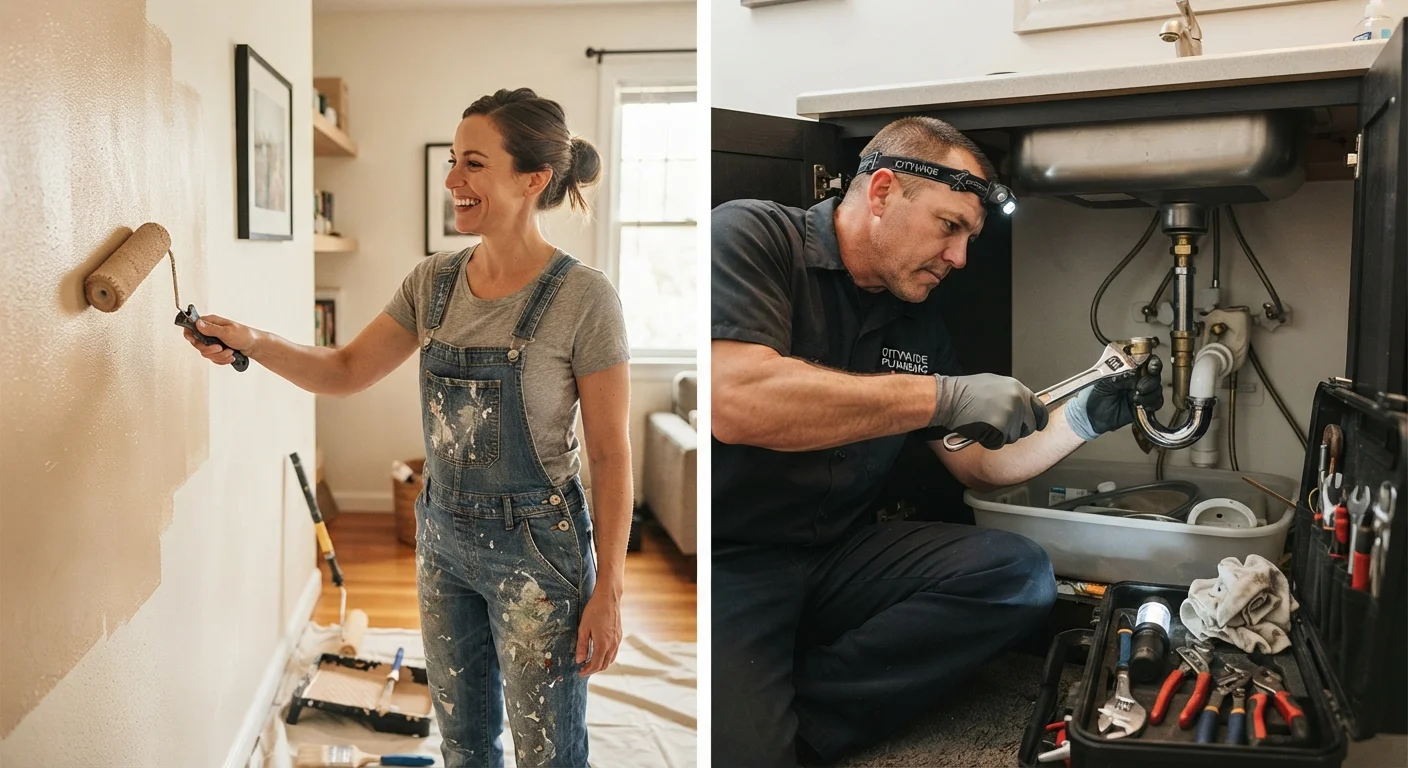
The Real Question Behind Every Home Project
Every homeowner eventually stands in front of a leaky faucet, a cracked tile, or a wall that needs opening up and asks the same question: Can I do this myself? The honest answer depends on more than YouTube tutorials and optimism. It depends on the nature of the task, the consequences of getting it wrong, your genuine skill level, and local regulatory requirements.
This isn't a debate about pride or frugality. It's about matching the right approach to the right job — and understanding that both DIY and professional help have a legitimate place in home ownership. See our guide to when renovation permits are required as a starting point, since legal requirements often settle the question before skill ever enters the conversation.
Where DIY Genuinely Makes Sense
DIY earns its reputation on jobs that are cosmetic, low-stakes, and forgiving of beginner mistakes. Painting interior walls, installing peel-and-stick backsplash tile, replacing cabinet hardware, caulking a bathtub surround, laying floating vinyl plank flooring, or patching small drywall holes are all tasks where the tools are accessible, the techniques are learnable, and an error can be corrected without endangering anyone.
Direct labor cost savings on straightforward tasks
Labor often represents 30–50% of a project's total cost. Handling cosmetic or simple maintenance tasks yourself captures that margin without requiring specialized training.
Builds genuine knowledge of your home
Completing DIY projects gives you a working understanding of your home's materials and systems, making you a better-informed client when you do hire a professional.
Flexible scheduling on your own timeline
DIY projects move at your pace, which matters for smaller jobs where waiting weeks for a tradesperson's availability would be disproportionate.
Cosmetic mistakes are usually low-stakes and fixable
On painting, tiling, or hardware installation, errors are typically visible, contained, and correctable without structural or safety implications.
The savings can be real — labor often accounts for 30–50% of total project costs on straightforward jobs. Beyond the money, DIY builds practical knowledge of your own home's systems, which makes you a better-informed client when you do hire a professional. The trade-offs between flooring types, for example, become much easier to evaluate once you've installed a floor yourself.
Where Hiring a Professional Is the Right Call
Certain categories of work carry consequences that go far beyond cosmetic setbacks. Electrical panel upgrades, new circuit installation, gas line work, load-bearing wall removal, roof replacement, and plumbing connections to the main supply line all fall into this territory. Errors in these areas can cause fires, flooding, structural collapse, or carbon monoxide exposure — risks that make professional licensing genuinely meaningful, not just a formality.
Serious safety risks in regulated trade work
Electrical, gas, and structural tasks carry injury and property-damage risks that are not recoverable with a second attempt. Mistakes in these areas can be life-threatening.
Legal and insurance complications from unpermitted work
Work that legally requires a permit and licensed contractor — but is performed without one — can create problems during home sales, insurance claims, and municipal inspections.
Incorrect DIY can cost more to fix than hiring upfront
A professional hired to correct faulty DIY plumbing, tiling, or framing often charges more than the original job would have cost, because repair work is typically more complex.
Skill and tool requirements are often underestimated
Many tasks that appear simple in instructional videos require practice, precision tools, and familiarity with materials — gaps that become apparent only mid-project.
Time investment is frequently higher than expected
Research, material sourcing, preparation, rework, and cleanup routinely double or triple the hours a first-time DIYer anticipates for a given project.
There are also practical legal realities. Many jurisdictions require licensed tradespeople to pull permits for this type of work, and homeowners who perform or hire unlicensed workers for regulated jobs can face problems when selling the home, making insurance claims, or passing inspections. Understanding hidden renovation costs — including permit fees and professional inspections — helps you budget honestly when a tradesperson is genuinely necessary.
How to Evaluate Your Own Readiness
Before committing to either path, run through a few honest questions. Do you have the specific tools the job requires — not approximations, but the actual equipment? Have you completed similar work before, or will this be your first attempt on a task with little margin for error? Do you have the time to do the job properly, including research, preparation, and any rework?
The Hybrid Approach Is Often Underused
Many homeowners treat the DIY vs. professional decision as all-or-nothing, but a hybrid approach is frequently the most practical option. Homeowners can handle demolition, painting, and finishing work themselves while a licensed tradesperson completes the regulated, technical phases. This model requires clear coordination but can reduce total labor costs without cutting corners on safety or compliance. Discuss the division of labor explicitly with any contractor before work begins.
If the answers reveal significant gaps, that's not a reason to feel inadequate — it's useful information. Partial DIY is often the most practical approach: homeowners handle demolition, painting, and cleanup themselves while a licensed tradesperson handles the regulated technical work. This hybrid model can meaningfully reduce labor costs without compromising safety. When you do hire, understanding how tradespeople quote jobs helps you evaluate proposals with confidence.
30–50%
Labor share of typical home project costs
Industry estimates consistently place labor at roughly a third to half of total project costs on standard home improvement work, making it the primary driver of DIY savings potential.
~1 in 3
DIY projects that require a do-over
Home improvement surveys have found that a substantial share of DIY attempts require at least partial correction, most commonly due to underestimated complexity or missing tools.
Working with a Tradesperson Effectively
Choosing to hire a professional doesn't mean handing over all control. Good project management — written quotes, clear scope documentation, and structured check-ins — protects both parties and keeps projects on track. Our article on communicating effectively with tradespeople outlines the practices that consistently lead to better outcomes. Verify licenses and insurance before work begins, and ask for references on projects similar in scope to yours. A qualified tradesperson will not hesitate to provide them.