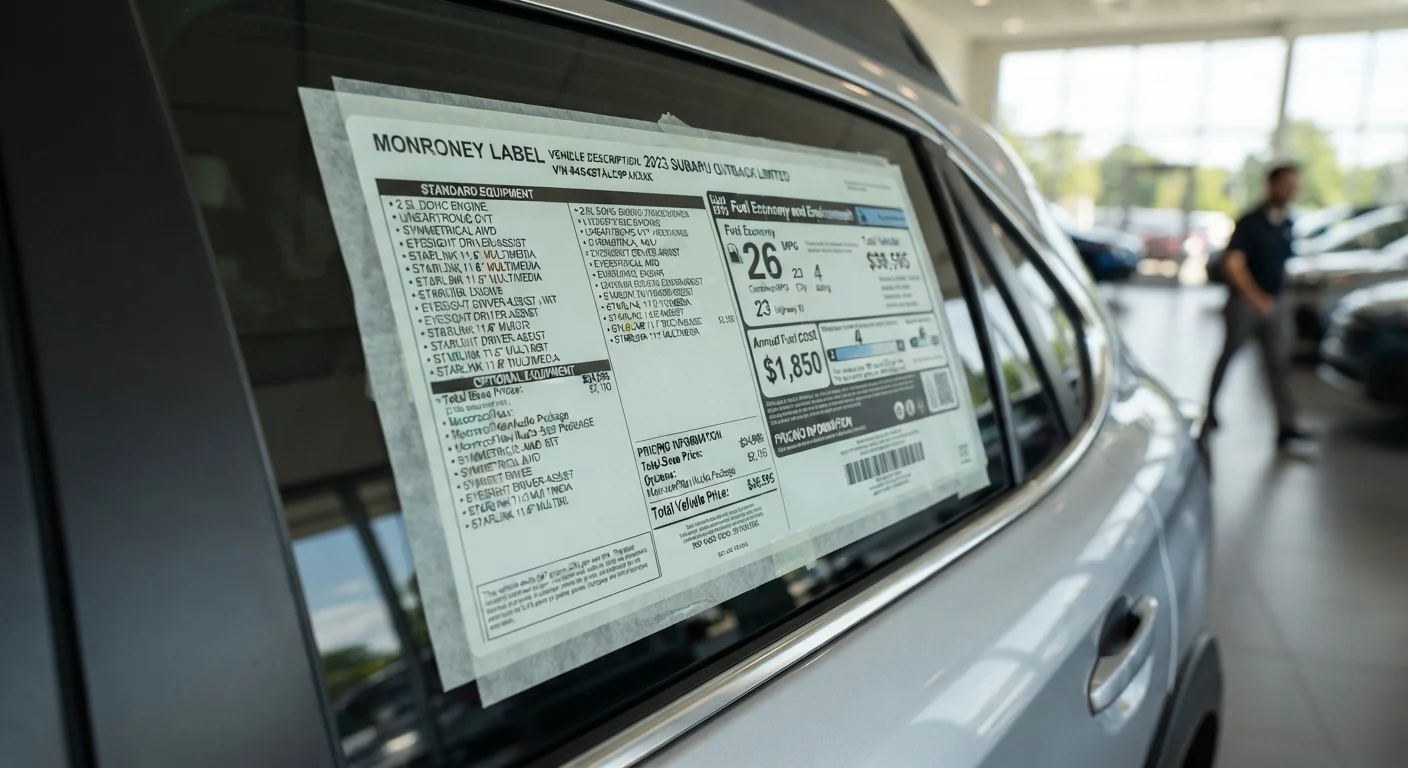
What the Monroney Sticker Is and Why It Exists
The term Monroney sticker comes from Senator Mike Monroney of Oklahoma, who sponsored the Automobile Information Disclosure Act of 1958 — the legislation that made the sticker mandatory. Before that law, car buyers had little standardized information about what they were buying or what a fair price looked like. The act required manufacturers to affix a label to every new passenger vehicle disclosing the base price, installed options, and destination charge.
Today, the sticker's scope has expanded to include EPA fuel economy ratings, safety ratings, emissions data, and country-of-origin information. If you are still building context around how manufacturers categorize and describe new vehicles, the article on what automakers mean when they call a car 'new' is a useful companion. The Monroney is your most reliable data source at the point of sale — more reliable than verbal descriptions, brochures, or dealer websites.
Never Remove the Sticker Before Sale
Federal law — specifically the Automobile Information Disclosure Act of 1958 — requires the Monroney sticker to stay on the vehicle window until it is purchased by the first retail buyer. Removing it before that point is a federal violation. If a sticker is missing from a new car on a lot, ask the dealer to produce it before proceeding.
What You Need Before You Start
Reading a Monroney sticker doesn't require specialized knowledge, but a few resources will help you get full value from the information it contains.
What you will need
Smartphone camera
Photograph the full sticker for later reference and price comparison.
EPA Fuel Economy Guide (fueleconomy.gov)
Cross-check the sticker's MPG figures against the official EPA database.
Manufacturer's build-and-price configurator
Verify that listed options and packages match the vehicle you are evaluating.
Photograph the Sticker Before Test Driving
The sticker contains more data than most people can absorb during a dealership visit. Taking a clear photo lets you review fuel economy details, option pricing, and the VIN at home without sales pressure. You can also use the VIN to cross-reference the vehicle's configuration on the manufacturer's website.
How to Read Each Section of the Sticker
The steps below walk through the sticker from top to bottom — the order it is physically laid out on most vehicles. Following this sequence ensures you don't skip sections that affect the total price or your understanding of what the car actually includes.
Locate and Identify the Official Monroney Sticker
The Monroney sticker is typically affixed to the inside of the side window — most often the rear passenger window. It is printed on a standardized form and carries the manufacturer's logo at the top. If a dealer has placed a second sticker nearby, note it separately; only the manufacturer-issued document is regulated under federal law.
Read the Vehicle Identification Block
At the top of the sticker you'll find the vehicle's make, model, trim level, model year, and the 17-character Vehicle Identification Number (VIN). The VIN is your most important reference point — it uniquely identifies that specific unit and encodes the manufacturing plant, engine type, and production sequence. Note it down; you can use it to verify the vehicle's history and confirm the listed options match what was actually built.
Review the Standard Equipment List
Below the vehicle identification block, the sticker lists all features that come standard at that trim level — things like the base engine, transmission type, safety systems, and infotainment features. This section tells you exactly what is included in the base price. Do not assume features are present because they are common in the segment; verify them here.
Examine Optional Packages and Individual Add-Ons
The next section breaks out factory-installed options — either as bundled packages (e.g., a Technology Package or Premium Package) or individual line items. Each entry shows a description and a price. Add these prices together and to the base MSRP to understand what portion of the total is driven by options. Some packages duplicate features already in another, so read descriptions carefully before assuming unique value.
Decode the Fuel Economy Section
A prominent section — often color-coded — displays EPA fuel economy estimates in miles per gallon (MPG) for city driving, highway driving, and a combined figure. For plug-in or electric vehicles, you will see MPGe (miles per gallon equivalent) and, for pure EVs, an estimated range in miles. These figures come from standardized EPA test cycles. Real-world results vary based on driving habits, climate, load, and terrain. The sticker also shows estimated annual fuel cost based on average mileage and a stated fuel price — treat this as a comparison tool, not a personal forecast.
Check the Safety Rating Section (If Present)
Many Monroney stickers include crash-test ratings from the National Highway Traffic Safety Administration (NHTSA), displayed as a five-star system, and/or ratings from the Insurance Institute for Highway Safety (IIHS), which uses Good/Acceptable/Marginal/Poor grades. Note that NHTSA and IIHS use different test protocols — a vehicle may perform well under one methodology and differently under another. If safety ratings are absent from the sticker, look them up separately on the agencies' websites before making a decision.
Confirm the Final MSRP and Country of Origin
The bottom of the sticker shows the total MSRP — the sum of base price, options, and any destination and delivery charge (a federally regulated freight fee that is non-negotiable). The sticker also lists the country where the vehicle was assembled and the domestic and foreign content percentages of major components. This is informational context; it does not affect the price. The total MSRP is a starting point for price discussion, not a fixed transaction price.
Dealer Add-Ons May Inflate the Final Price
Many dealerships attach a secondary sticker alongside the Monroney listing dealer-installed accessories, protection packages, or market-adjustment fees. These are not part of the federally regulated Monroney — they are negotiable. Always identify which sticker is the manufacturer's original before comparing prices.
After You've Read the Sticker
Once you have worked through the sticker, you have a clear picture of exactly what vehicle is in front of you — its configuration, price components, efficiency profile, and safety credentials. This positions you to have a more informed conversation about price and to compare multiple units objectively.
Before you finalize anything, review the pre-delivery checklist for new cars — even factory-fresh vehicles can arrive with issues worth identifying before you take ownership. And if you are earlier in the process of understanding new car terminology and financing concepts, the first-time buyer's map to the new car market covers the broader landscape in accessible terms.