Where the Rule Comes From
The 50/30/20 framework gained mainstream attention through the 2005 book All Your Worth by Elizabeth Warren — then a Harvard law professor specializing in bankruptcy — and her daughter Amelia Warren Tyagi. Their core argument was that financial stress often stems less from overspending on lattes and more from structural imbalances between fixed obligations and income.
The rule was meant to be simple enough to use without a spreadsheet. Rather than assigning a line item to every dollar, it offers three broad buckets that most people can immediately relate their spending to. That accessibility is a large part of why it remains one of the most widely taught personal budgeting frameworks today.
This article is for general educational purposes and does not constitute personalized financial advice. For guidance specific to your situation, consider speaking with a licensed financial professional.
Breaking Down the Three Buckets
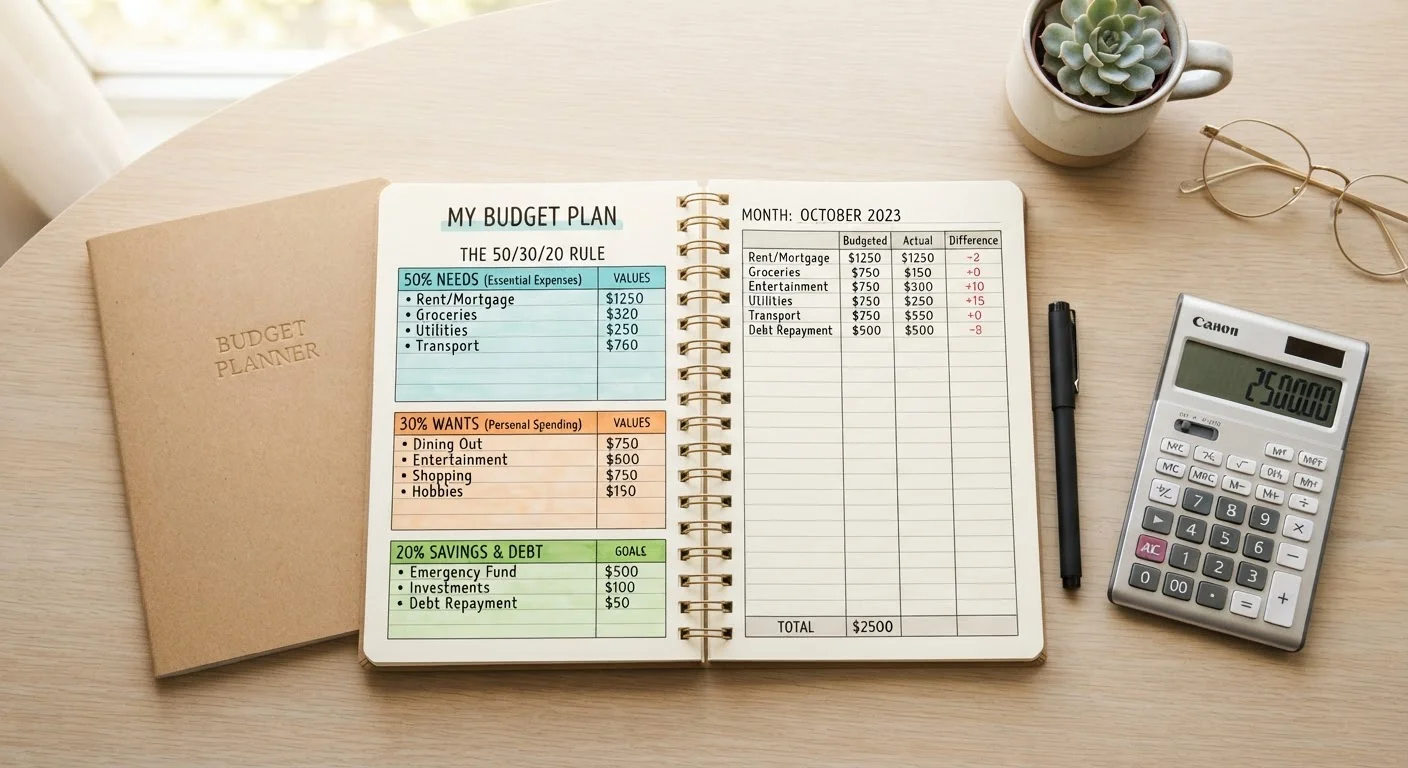
50% — Needs
The needs category covers essential expenses: housing costs (rent or mortgage), utilities, groceries, basic clothing, health insurance premiums, minimum loan or credit card payments, and transportation to work. These are costs you genuinely cannot skip without serious consequences.
A useful test: if you stopped paying it, would your health, housing, or employment be at risk? If yes, it's likely a need. If the answer is "no, but it would be inconvenient," it probably belongs in wants. For a more detailed exploration, the distinction between needs and wants is worth examining carefully.
30% — Wants
Wants are lifestyle choices: streaming services, restaurant meals, gym memberships, vacations, new electronics, and entertainment. These aren't bad spending — they're part of a sustainable, enjoyable life. The 30% allocation acknowledges that a budget that eliminates all discretionary spending is rarely maintainable long-term.
20% — Savings and Debt Repayment
This bucket serves two purposes: building financial security and reducing what you owe. It covers contributions to emergency funds, retirement accounts, and other savings goals, as well as debt payments above the required minimum. If you're carrying high-interest debt, many financial educators suggest prioritizing it within this 20% before building savings beyond a small buffer. For practical mechanics on building a savings cushion, see our guide on automating your savings.
50%
Recommended ceiling for essential expenses
The 50/30/20 framework, as described in Warren and Tyagi's "All Your Worth," recommends keeping needs at or below half of take-home pay.
~33%
Median share of income spent on housing alone
According to the U.S. Bureau of Labor Statistics Consumer Expenditure Survey, housing consistently accounts for the largest single share of American household spending, often making the 50% needs target challenging in practice.
20%
Savings and debt repayment target
Many mainstream personal finance educators, including FDIC-supported materials, use the 20% savings benchmark as a general guideline for building long-term financial security.
When the Framework Works Well — and When It Doesn't
The 50/30/20 rule is best suited to people with stable, predictable income who want a straightforward structure without detailed tracking. It's particularly useful as a starting point for someone budgeting for the first time, or as a quick sanity check on whether spending is broadly balanced.
Adjust the Percentages to Fit Your Reality
There is nothing sacred about the exact 50/30/20 split. If your needs genuinely consume 60% of your income, you might work with a 60/20/20 or 60/25/15 structure as an interim goal. The value of the framework is in making trade-offs visible — not in hitting specific numbers perfectly from day one.
The framework has real limitations. In high-cost metropolitan areas, rent alone can consume more than 50% of take-home pay for many households, making the target aspirational rather than achievable in the short term. Lower-income earners may find that needs reliably exceed 50%, leaving little room for the wants and savings categories.
The rule also offers minimal granularity. Unlike zero-based budgeting, which assigns every dollar a specific job, the 50/30/20 method won't catch subtle overspending within a category. Someone could stay within the 30% wants limit while still accumulating debt if their needs are misclassified.
For households managing shared finances, the framework can still apply — just to the combined income. Budgeting as a household introduces additional variables worth considering when more than one income or set of priorities is involved.
Putting It Into Practice
Start with your actual monthly take-home pay. If you're salaried, that's your net paycheck total for the month. If your income varies, use a conservative average based on recent months.
Multiply that figure by 0.50, 0.30, and 0.20 to get your three target amounts. Then review last month's actual spending — most banks and credit card providers offer spending category summaries — and compare what you actually spent in each bucket to your targets.
Don't try to fix every gap at once. Identify one or two adjustments that would move you meaningfully toward balance. Reducing a recurring subscription, renegotiating an insurance rate, or redirecting a small raise toward the 20% bucket are all concrete starting moves. Building an emergency fund is typically the first savings priority for most financial educators, before focusing on longer-term goals.
The 50/30/20 framework is a guide, not a verdict. If your numbers don't match the targets, you haven't failed — you have useful information about where your money is currently going and where you might want it to go instead.
This article is for general informational and educational purposes only and does not constitute personalized financial, tax, or investment advice. Readers should consult a qualified financial professional before making decisions specific to their own financial circumstances.