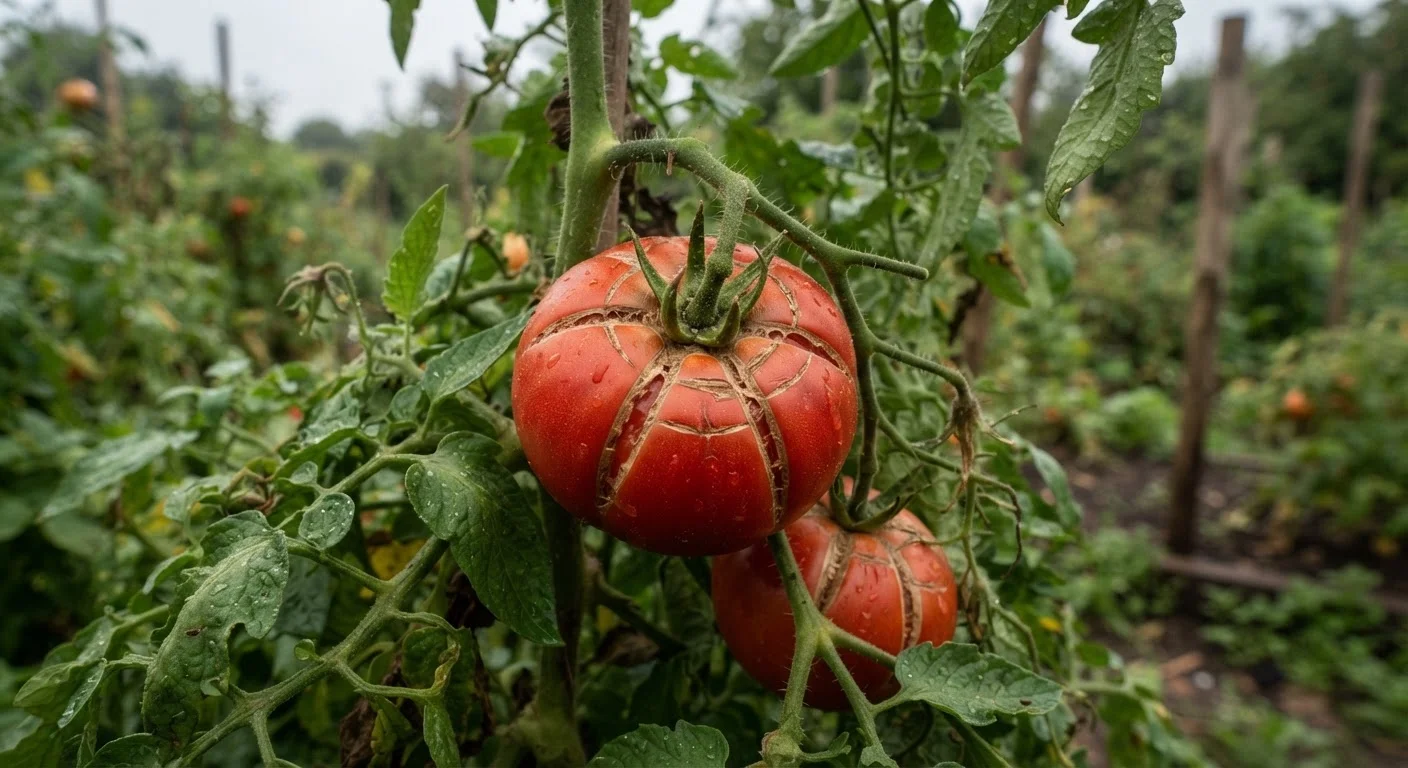
What's Really Happening When Tomatoes Crack
Tomato cracking — technically called fruit splitting — happens when the inside of the tomato grows faster than its skin can accommodate. The skin, which has been toughened by dry or stable conditions, simply cannot stretch quickly enough and ruptures along the path of least resistance. Cracks typically appear in two patterns: radial cracks that run from the stem downward, and concentric cracks that circle the fruit in rings closer to the blossom end.
Both patterns share the same root cause: an abrupt change in the rate at which the fruit is taking up water. Understanding this mechanism is the first step toward preventing it — because no spray, fertilizer, or product can compensate for the underlying environmental stress driving the split.
Letting soil moisture fluctuate dramatically between waterings.
Why it happens: Gardeners often water reactively — only when plants look stressed — leading to boom-and-bust cycles of drought and flood at the root zone.
Skipping mulch around tomato plants.
Why it happens: Mulching can feel like an optional extra step, especially for new gardeners focused on planting and fertilizing rather than soil management.
Over-fertilizing with nitrogen mid-season.
Why it happens: Eager gardeners assume more feeding equals bigger harvests, and they continue nitrogen-heavy feeding well into the fruiting stage.
Leaving fully ripe fruit on the vine during wet weather.
Why it happens: Gardeners often wait for fruit to reach peak color on the vine, not realizing that mature tomatoes are most vulnerable to cracking when hit with sudden moisture.
Planting only one variety without considering crack resistance.
Why it happens: Variety selection is often driven by flavor reputation or size rather than growing performance traits like skin thickness and crack tolerance.
How to Protect Your Crop Going Forward
Preventing tomato cracking is largely a matter of creating consistency in your garden's moisture environment. Start by applying a 3–4 inch layer of organic mulch — straw, shredded leaves, or wood chips work well — around the base of each plant. Mulch buffers the soil from both rapid drying and sudden waterlogging, smoothing out the moisture swings that trigger splitting.
Overhead Watering Adds Hidden Risk
Watering tomatoes from above — with a sprinkler or hose sprayer — can wet foliage and fruit surfaces in addition to the soil. This contributes to fungal disease pressure and uneven moisture delivery. Switching to ground-level drip or soaker irrigation reduces both cracking risk and disease incidence in the same step.
Invest in a drip irrigation system or soaker hose on a timer if hand-watering has been inconsistent. Delivering water slowly and directly to the root zone is more effective than overhead watering, which can also promote foliar disease. Aim for deep, infrequent watering rather than light, daily sprinkles — the goal is to keep the root zone steadily moist 6–8 inches down.
If you're selecting seeds or transplants for next season, look for varieties described as crack-resistant. Traits like thicker skin and more balanced sugar-to-water ratios in the fruit make some types significantly more forgiving of variable conditions. Your local cooperative extension office can recommend varieties well-suited to your specific regional weather patterns.
Finally, monitor the forecast. During a prolonged dry stretch followed by predicted heavy rain, consider harvesting any tomatoes that have reached the breaker stage — when the fruit shows the first blush of color. They will ripen fully indoors at room temperature and won't crack on the vine during the downpour.
Cracking Is a Cultural Problem, Not a Product Problem
No spray, supplement, or soil amendment can reliably prevent tomato cracking if watering practices remain inconsistent. The most effective interventions are free or low-cost: a mulching habit, a steady watering schedule, and timely harvesting. Focus on environmental consistency before reaching for any packaged solution.